THE PEDAGOGY OF THE POETIC BODY

If pedagogy is the art of transmission, is there an art of transmitting pedagogy?
Is there a pedagogy for pedagogy?
Or a pedagogue of pedagogues?

These questions are at the roots of the field of pedagogic training and all its variations: teacher training, mentoring, pedagogic supervision, pedagogic consulting, pedagogic assistance.
In this phase of my life and career, the transmission of the Pedagogy of the Poetic Body has become crucial. Not just the training of theatre practitioners, but the spreading of the vital principles of this practice.
I like to call my teaching work pedagogic practice. All practices can be trained, developed, elaborated, criticized, rejected, unfolded, transformed, evolved… composted in order to nurture new practices.

In the learning of a pedagogic practice, there are several phases.

The first one is when you learn a particular art from a teacher or a practitioner. In the moment you’re learning that art you’re also learning the way in which this teacher is transmitting the art. There is a direct mimesis between the teacher and the learner: what you learn includes the way you have learnt. And this includes the particular style of your teacher. Sometimes even some of their personality traits.

The second level of learning happens when as a teacher, you decide to teach that particular art or that particular subject and you learn from yourself what and how you want to teach. You learn from your findings and from your errors. You learn from your intuitions and from your questions. You learn from your excitement and from your fear. And you learn form your students: from their findings and from their feedback. And, most of all, your learn from the work itself: the Muses of theatre are always there, breathing in your breath.

Another level of learning happens if you share the teaching with a colleague and you co-create the work. A two-mind, two-heart, two-body pedagogic sonata. Or a pedagogic chorus if you work in a team.

The further level happens when you look for guidance in a training field with an elder teacher, whose task is specifically to nurture your pedagogic practice: your technique, your skills, your vision, your style and your awareness of it. In a learning chorus with other teachers in training.

If you’re interested in developing your practice as a teacher, pedagogue or theatre educator, or as an educator who uses theatre in their practice, in this website you can find several resources that can nurture your pedagogic work.
Some workshops and training are planned in the upcoming months.
And there are two new texts in the writings session. One on the evolution of Helikos Pedagogy and the other on the infamous “Via Negativa”, an ancient philosophical term often misused in the context of theatre pedagogy.

I wish you great inspirations and the blooming of many new synapses in your beautiful poetic brain.

ONLINE PRACTICE

ONLINE PRACTICE

The essence of feedback is in recognizing patterns
and bringing them into awareness
The art of describing forms as they manifest
Rigorous, empathic and poetic phenomenology
Forms are Masks, Masks are Forms

Figures emerging from the background
Masks are three-dimensional
at least
And so is theater
A screen is a bi-dimensional landscape

A space of longing
An echo of the poetic space
A surrogate, a memory, a survival raft

I don’t teach physical theater on-line. I find that it is not a viable way to initiate new students to this art, to this work, to play.
I have written a post to unfold the reasons behind my choice. You can find it in the Blog of this website.

There is no such a thing as Virtual Physical Theater. There is on-line performance, and I am not interested nor skilled at it, so I cannot teach it. In the words of my colleague and friend Amy Russell, if there is no shared space and shared time, it is NOT theater. It is something else. It can be great, but it is not theater. And it is not my cup of tea, nor my glass of wine.

We all need to be careful with the words we use to describe the world. They create it. And they can damage it.

These are very difficult times, and live arts have been hit very hard by the pandemic. Many colleagues in the teaching field had no alternatives between going on-line and loosing their job. Others had long term programs to run, enrolled students to support, teaching staff to protect… Some very difficult choices needed to be taken. I feel for them.
I consider myself lucky to not having been in that situation. I am in the fortunate position in which I did not have a job to preserve. As a free-lance teacher and artist, I work but I do not have a job. I am subject to the seasons of nature and history. It is exciting and risky. I found this to be the operating mode that most serves the way I like to live and work.
When the pandemic hit, I turned off my calendar and I went on stand-by.
And I braced for this sudden Ice Age.

As everyone, I was fully unprepared to face this level of disruption. I had good harvests in the years before the pandemic and my living costs were low, so I could survive with my reserves and a strict diet.
But I miss the work tremendously, and the play, and the people, and the magnificent feeling of collective practice.
This is an exceptionally long and cold winter of the Live Arts. No outdoor gardening is possible and I need to keep practicing to maintain the fertility of the soil. Precious relationships need to be nurtured in whatever way is available. So I am exploring the possibilities offered by the online medium.

What I have discovered during these two years of pandemic, is that Zoom can be a greenhouse, or a nursery. Some gardening is possible. Some plants are actually doing OK, a few can even thrive. The remote connection can be a precious tool to maintain and cultivate relationships, to reflect on the work, to support each other emotionally, to refresh theoretical understanding, to review exercises. Some basic movement practices are possible, as well as some levels of writing and devising processes. And, of course, we can all prepare for the return to the fields.
It’s about keeping the fire alive, the soil worked, the seeds protected. And it can be very heartwarming, which is a priceless gift these days.

While collective work online is very seriously maimed, individual work maintains more potential. And it can operate as a an emergency channel. This damn pandemic eventually will end, and we will be grateful for the flames kept burning.

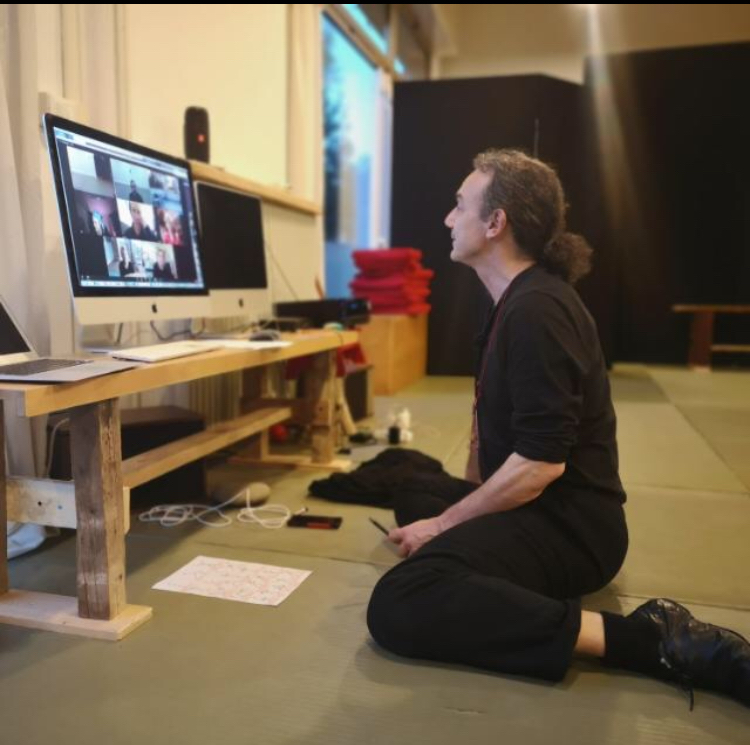
This is how Online Theater Pedagogy looks like.
The “pedagogy of the legless” in the words of Marcel Jousse


For all these reasons I prefer to call my work on-line PRACTICE, rather then teaching.
What I offer is

  • Individual consulting on devising projects
  • Individual pedagogic supervision or coaching
  • Pedagogic supervision in group
  • Theory classes and online conversations on specific subjects

I work only with practitioners with whom I have already worked and played in the context of live training, and who are active in the field. Or at least who have been active before the Covid storm.
If I don’t have already a preexisting embodied experience with a person and with their practice, I cannot establish a valid pedagogic engagement and relationship.

This is NOT the New Normal. It is a difficult, frustrating and challenging abnormal. In history, as in life, shit happens and this pandemic is a colossal one. Please remember and cultivate the longing for what we are missing and the grief for what has been lost. When this will be over, come back to the live poetic space wilder and more embodied than ever before. I’ll meet you there.


Giovanni Fusetti
January 202
2


WHY I DON’T TEACH PHYSICAL THEATER ONLINE

ANTIVIRAL NOTES IN DEFENSE OF THE PEDAGOGY OF THE POETIC BODY.

There is no such a thing as Virtual Physical Theatre. As much as there is no such a thing as Virtual Gardening. Or Digital Hiking. There is performance on-line. There is coaching on zoom. There is pedagogic supervision. There is facilitation of creative processes. There are conversations on the work, review of exercises and theories. There can be practice with the creative potential of the medium. There are plenty of options. Can we teach and learn online? Certainly we can. The question is what.

We can practice a live embodied art online as long as we are aware that it is a surrogate of the real experience. As long as we frame it as such.

During this pandemic pandaemonium, in the impossibility of live events, we have gathered online to keep the flame burning. I have done it too and I am having some great experiences with former students or practitioners with whom we have ALREADY experienced the work and the play in its live form. We already have a common poetic body and space to practice in, and we already have an embodied experience of each other. So we know where the work comes from and where it will end: in a live and embodied shared poetic space and time.

Can I teach that poetic space and time to new students online?
Can I teach the profound collective ecstasy of the theatrical event online?
Can I hold the space for the alchemy of the co-creation between the player and the audience?
Can I facilitate the unfolding of clowns, characters and bouffons with the full support of the embodied emotional energy of the class and of myself?
Can I give feedback on the stupendous variety of embodied events that appear at the threshold between the person and the mask, between the mask and the space, between the space and the audience, and eventually between us all and the Goddesses and Gods of theater?
My answer is No.

That is why I am not doing online training in physical theater with new students. It would be a professional cheat on my side. I would be teaching a surrogate to a beautiful art. In doing this I would disrespect, diminish and eventually damage the individual and collective poetic field. And myself in it.

The virtual cannot replace the authentic.

We can do online training in online performing. I think this is a whole new genre there, to be explored and developed. Certainly great work is emerging. But I am not interested. It’s not my medium. As much as I don’t do video or cinema – I love good videos and movies. Those are wonderful arts but not my practice, nor my skill. I do movement based theater, also known as physical theater. It is the best technology I know to explore the world as it is and as it could be. And to communicate it.

I love my practice and I love teaching it. Now I miss it tremendously.
In these times of absence I am cultivating the longing-craving-dreaming-starving-burning desire for the return of the bodies with bodies. Now it’s winter, and there is snow on our fields. Spring will come. It might take long. The empty space is where the poetic potential prepares the next gestures and the emergence of the forms of the new stories.

Theater has survived far worse scenarios than this.

The Venice plague of 1575 killed 50,000 people, which at the time was a third of the population of the city. You make the comparison with our Covid numbers.

Formally, Commedia dell’Arte appeared in Padova in 1545, and was in full bloom by the end of that century. The contagion was just a pause in the unfolding of this stupendous art. A stand-by, a call of movement.
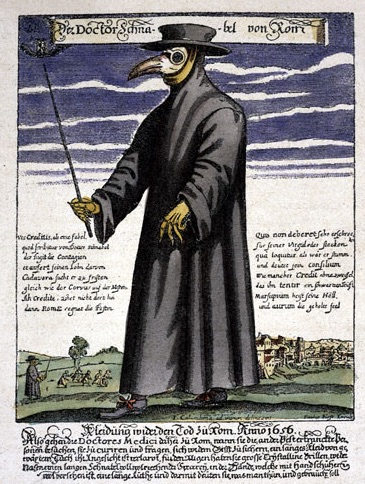
The Plague was a returning event in the following century and Venice Carnival created a new character, il Medico della Peste (The Plague Doctor) to acknowledge it. The costume was based on the outfit doctors were using to protect themselves from the contagion: ankle length black robes, white gloves and a large beaked mask with small glass eye holes. Inspired by the strong aesthetic of the newcomer to the mask family, many of the Venice Carnival Masks got an upgrade and grew longer noses.

Illness, symptoms and the fear of dying are recurrent themes in the comic lazzi of Commedia dell’Arte.
Will we dare to face The Covid with the wild humor of our ancestors?
Will we improvise the Lazzo of Arlecchino sanitizing his hands?
Will we create a new type to play with our collective experience of this new plague?
Shall we name him Covidello? This will be a tribute to one of the most ancient servants in Commedia, Coviello, whose origins are in the ancient Latin fertility rituals. He will be our new version of the Fool who, as long as keeps playing, cannot die.Will we write the Adventures of Covidello in the City of the Virus?
Will we perform it in our streets or on zoom? It’s our choice, and this choice will define the world we will want to live, love, work, play, laugh and die in.


Giovanni Fusetti

Padova, Italy, May 31st, 2020

ONLINE THEATRE ?

It is the end of Spring 2020. I am stuck in Italy. Theatres and studios are closed. I cannot travel, my potential students cannot travel. My work has vanished. And I have a new option in front of me. Teaching physical theatre on-line.

Shall I?

I am new to this remote option. Before Coronas, I have had occasional experiences with this option, uniquely through Skype, in the form of individual coaching sessions or supervision sessions, or directing sessions with up to three people together on the other end of Skype. Or I have recorded myself talking and then I have sent the audio or video to be watched in a differed time and space. But this was always with people with whom I had a previous live experience.

During the first months of the pandemic I have explored the Zoom medium and it has been very interesting.
The first observation is that during a zoom gathering I rely on my previous experience with the people I am connecting with.
I have had a few meetings, discussions and lectures with groups in which I knew only some of the participants. My perception of the known and unknown participants was completely different. It had very different “weight”. With the person I already know, I noticed that I can tap into my lived experience of a physical and emotional contact, which creates a shared space. And that space can contain a new experience that will expand and enrich our common story. People who have already met and who have been working and playing together in the embodied field, are already engaged with a space, which is, at the same time, physical, emotional and poetical. The zoom participants will pop into the shared common body and the experience can be very interesting. It can be fun and can fulfill some of the potentials of getting together.

If the meeting or the gathering happens for the first time on this medium, then I feel a terrible loss of reality and gravitas, and my engagement with the person is significantly dimmed. I question whether this is a viable option or just a very poor surrogate contact, that will be more frustrating than creative. At the moment I tend towards this second option.

Coming to something more specific to my practice of teaching movement theater, I have noticed that if the shared practice is based on technique and the learning of some “ forms”, my role becomes more “the instructor” who demonstrates certain techniques to be learnt by observation and imitation. The interaction with the audience is limited. In this case zoom offers some interesting opportunities.

During the first lockdown I held a series of classes reviewing the 20 Movements of Lecoq with a group of former pedagogic students. It was surprisingly fun and I think there is a potential of working on this format to turn it into something viable. Somehow the teacher on zoom facilitates individual learning processes on the other side of the screen.

But if the practice requires direct live interaction between the audience and the player, then we are in a very different scenario.

This is why a movement class on zoom has more chances than improvisation. The problem within the zoom space is that the feedback from the audience is unreceivable and unusable, for a variety of reasons. For example, the text and the sound of the various speakers cannot be heard at the same time and timing, and this kills the dynamic interaction between the actor and the audience.  It is likely that, in the future, the zoom software will improve some of the current limitations, but I still feel that the quality and value of the audience feedback mediated by the bi-dimensional images, combined with and the lack of the shared physicality, will remain extremely frustrating. I don’t think a collective improvisation class on zoom has many chances to provide anything better than a poor surrogate.

Another observation is that when I am teaching standing in front of the small screen, my perception of the audience and my pedagogical use of it are extremely limited. And again, if I already know the people, I can tap into my experience of them. But if I have never met them, this makes my perception of the group close to nothing. And even if I can tap into my previous experience of the group, I feel very alone out there and I’m working very hard to maintain some connection with the participants. I can rely almost uniquely on my experience of my own body and my presence becomes more of a solo pedagogic performance. This makes me fundamentally sad.
My experience of lecturing on zoom was one of the most bizarre and frustrating moments of my teaching career. The aftermath was an intense physical unhappiness, something I could compare to a food poisoning.

I think we can keep exploring this zoom medium and find the best use of it, but, at the end of the story Theater on-line is not Theater. It is something else.

It seems to me essential to affirm and to defend the difference between Theater, which is a live event “in a shared space and time” (Amy Russell 2020), and television or videomaking.  We can certainly turn our classes into recorded lessons that people will listen to in their own space at their own time, or we can turn our creations into videos that will be watched on YouTube or Vimeo. But this is another art.

It is important that we keep very clear the distinction between live theater and video making or cinema. I see a lot of confusion when actors, comedians and theater companies are invited to present their work online. As theater practitioners, we have always known that the video recording of a theater a piece will kill it, unless specific skills in film making and editing are used. And we are talking about the recording of a show with a live audience in it. Just filming theater and putting it online, or live streaming shows without live audience seems to me a catastrophic choice. Some kind of public euthanasia of an entire art form.

Funding a company to put their shows online is like paying someone to dig their own grave. I know we all have to bring our bread on the table but this is a poisoned cake.
Sometimes starving is better then eating junk food.
And these days, resistance seems the only way of protect our existence.

As a practitioner of movement based theater, also known as physical theater, I will resist with all my flesh and bones, muscles and masks, feet and legs, body and soul, to save it from a migration online that will declare its death by mutation.
The idea that theater can exist and thrive online is, simply, insane.