THE PEDAGOGY OF THE POETIC BODY

If pedagogy is the art of transmission, is there an art of transmitting pedagogy?
Is there a pedagogy for pedagogy?
Or a pedagogue of pedagogues?

These questions are at the roots of the field of pedagogic training and all its variations: teacher training, mentoring, pedagogic supervision, pedagogic consulting, pedagogic assistance.
In this phase of my life and career, the transmission of the Pedagogy of the Poetic Body has become crucial. Not just the training of theatre practitioners, but the spreading of the vital principles of this practice.
I like to call my teaching work pedagogic practice. All practices can be trained, developed, elaborated, criticized, rejected, unfolded, transformed, evolved… composted in order to nurture new practices.

In the learning of a pedagogic practice, there are several phases.

The first one is when you learn a particular art from a teacher or a practitioner. In the moment you’re learning that art you’re also learning the way in which this teacher is transmitting the art. There is a direct mimesis between the teacher and the learner: what you learn includes the way you have learnt. And this includes the particular style of your teacher. Sometimes even some of their personality traits.

The second level of learning happens when as a teacher, you decide to teach that particular art or that particular subject and you learn from yourself what and how you want to teach. You learn from your findings and from your errors. You learn from your intuitions and from your questions. You learn from your excitement and from your fear. And you learn form your students: from their findings and from their feedback. And, most of all, your learn from the work itself: the Muses of theatre are always there, breathing in your breath.

Another level of learning happens if you share the teaching with a colleague and you co-create the work. A two-mind, two-heart, two-body pedagogic sonata. Or a pedagogic chorus if you work in a team.

The further level happens when you look for guidance in a training field with an elder teacher, whose task is specifically to nurture your pedagogic practice: your technique, your skills, your vision, your style and your awareness of it. In a learning chorus with other teachers in training.

If you’re interested in developing your practice as a teacher, pedagogue or theatre educator, or as an educator who uses theatre in their practice, in this website you can find several resources that can nurture your pedagogic work.
Some workshops and training are planned in the upcoming months.
And there are two new texts in the writings session. One on the evolution of Helikos Pedagogy and the other on the infamous “Via Negativa”, an ancient philosophical term often misused in the context of theatre pedagogy.

I wish you great inspirations and the blooming of many new synapses in your beautiful poetic brain.

PANDEMIC Calendar

To plan, or not to plan, that is the question:
Whether ’tis nobler in the mind to suffer
The slings and arrows of an outrageous virus,
Or to take Arms against a Sea of boredom,
And by opposing end them with a calendar?
To die, to plan no more; to say we end
The heart-ache, and the thousand unnatural shocks
of another lockdown? ‘Tis a resignation
Devoutly to be avoided. To plan, to dream,
To dream, perchance to Teach; aye, there’s the joy,
For in that burst of life, what dreams may come,
When we have shuffled off this mortal fear,
Must give us play, motion and clowns’ love
.

William G. Shakespeare

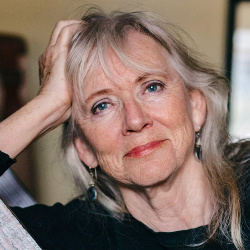
Joan Schirle

(1944-2022)

Rest in joy
dearest Joan

February 4, 2022


They arrived today
on a wooden canoe on the Mad River
They suddenly appeared on the crisp water
skillfully stirring on the current

They left the canoe by the bridge
and they are now walking in the streets of Blue Lake

Isabella Andreini is leading the company

We heard the news
she says with a smile
We are here for Joan
We are here to take her with us

Zanni is cursing and swearing
hiding his face behind his furry eyebrows

Arlecchino is jumping around
hopping his sadness away

Sta’ fermo !
Brighella shouts at him
Be quiet!
He’s holding a bottle of Carlo Rossi in his hand
and a barrel of tears in his belly

Colombina is humming a joyful tune
to push back her tears
It was such a joy and an honor
to be serving you Joan

Il Dottore is composing a tirata
Ludum vincit mortem
Play conquers death
Joanna pulcherrima est

Il Capitano is hitting the clouds with his sword
Yo soy, Yo soy, Yo soy…
so lost without you Joan

Pantalone is speechless
holding his head in his hands
No xe vero
It can’t be true
Not yet, not you, not now
C’est pas vrai Ostia!

The Innamorati are sobbing in tunes
I love you so much Joan !
I love you more !
Not as much as me !


Even Menato is here
He jumped off from another century
cursing loudly in his wild Paduan dialect
Putana mo’ del vivere
Damn bitchy life
Prima Carletto e desso ti
First Carlo and now you Joan
You still had so many scenes in the show!
Damn it!

Far in the distance
the Redwoods are weeping
and the Ocean is more pacific than ever

Isabella
the magnificent Isabella Andreini from Padua
orders everybody to stop in front of Dell’Arte

Joan is there
dressed in white
with her suitcase full of masks
and her witty blue eyes wider than the sky

She stands at the door of that vessel full of dreams
known as Dell’Arte
the magnificent gem
she carried in her body and soul
for decades of poetic joy

I am ready
she says
It is a little too soon
but I am ready
It has been an honor and a joy
to serve the Muses with your masks

She is smiling

Isabella walks towards Joan
and gently bows in front of her
The two women are standing there
in silence
they are whispering thank you

Two pillars of beauty and rigor
opera and joy
They are hugging each other
holding the universe in between their hearts

I died giving birth to my eighth child
Isabella says
You have lived giving birth
to a multitude of artists and poets
and to countless acts of joy
play, rigor and beauty

On behalf of all of the Masks
I thank you Joan

And I wish you Happy Birthday

Everybody is crying
the Masks, the birds, the clouds, the sky
the hills, the trees, the wind
and the Mad River
today madder than ever

And all the people of Blue Lake
and beyond
gathered here for Joan’s birthday
All the hearts she touched
and the countless masks who came into existence
under her caring fierce witty eyes

Brighella comes bobbing towards them
Carlo is waiting for you with Prosecco
You two have a lot to catch up on


Colombina picks up the suitcase
with a skip and a giggle
It’s time to go now

And Joan followed Isabella and the Masks
on their way back to the Mad River
They took a long time to leave
walking through her birthday party
There were so many hugs to give
tears to dance
and goodbyes to sing

And that’s how Joan left Blue Lake
in the company of the Masks
on her birth day
on a winter morning of Twenty Twenty-Two

They walked to the Mad River
and their canoe floated away
into the ocean and beyond…


Joan Schirle Obituary

Joan Schirle – Dell’Arte Website

Joan Schirle: The Ascent of a Legend , on American Theatre

A video link: Arlecchino Appleseed—How Carlo Mazzone Clementi Brought Commedia dell’arte to the New World—July 7, 2015 Blue Lake, CA


If you want to contact Giovanni or send him comments or feedback, you can write to
giovanni.fusetti@helikos.com


Follow GIOVANNI FUSETTI’S Blog

If you want to receive any new post directly to your inbox, you can sign up here.
Once you have signed up, you will receive an email with the link where you can edit your preferences.

ONLINE PRACTICE

ONLINE PRACTICE

The essence of feedback is in recognizing patterns
and bringing them into awareness
The art of describing forms as they manifest
Rigorous, empathic and poetic phenomenology
Forms are Masks, Masks are Forms

Figures emerging from the background
Masks are three-dimensional
at least
And so is theater
A screen is a bi-dimensional landscape

A space of longing
An echo of the poetic space
A surrogate, a memory, a survival raft

I don’t teach physical theater on-line. I find that it is not a viable way to initiate new students to this art, to this work, to play.
I have written a post to unfold the reasons behind my choice. You can find it in the Blog of this website.

There is no such a thing as Virtual Physical Theater. There is on-line performance, and I am not interested nor skilled at it, so I cannot teach it. In the words of my colleague and friend Amy Russell, if there is no shared space and shared time, it is NOT theater. It is something else. It can be great, but it is not theater. And it is not my cup of tea, nor my glass of wine.

We all need to be careful with the words we use to describe the world. They create it. And they can damage it.

These are very difficult times, and live arts have been hit very hard by the pandemic. Many colleagues in the teaching field had no alternatives between going on-line and loosing their job. Others had long term programs to run, enrolled students to support, teaching staff to protect… Some very difficult choices needed to be taken. I feel for them.
I consider myself lucky to not having been in that situation. I am in the fortunate position in which I did not have a job to preserve. As a free-lance teacher and artist, I work but I do not have a job. I am subject to the seasons of nature and history. It is exciting and risky. I found this to be the operating mode that most serves the way I like to live and work.
When the pandemic hit, I turned off my calendar and I went on stand-by.
And I braced for this sudden Ice Age.

As everyone, I was fully unprepared to face this level of disruption. I had good harvests in the years before the pandemic and my living costs were low, so I could survive with my reserves and a strict diet.
But I miss the work tremendously, and the play, and the people, and the magnificent feeling of collective practice.
This is an exceptionally long and cold winter of the Live Arts. No outdoor gardening is possible and I need to keep practicing to maintain the fertility of the soil. Precious relationships need to be nurtured in whatever way is available. So I am exploring the possibilities offered by the online medium.

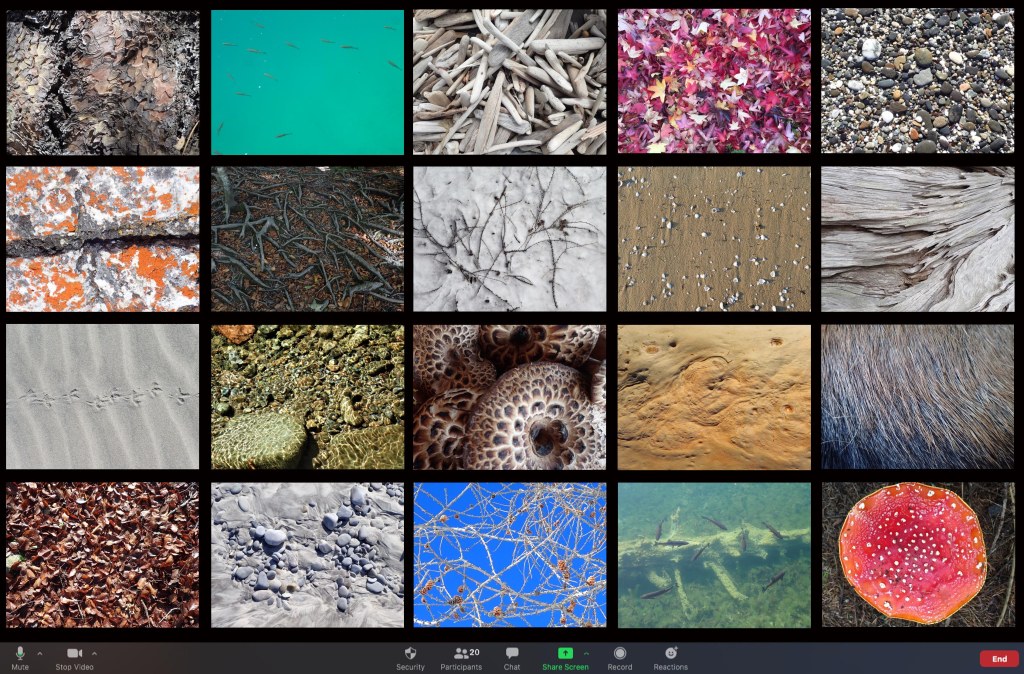
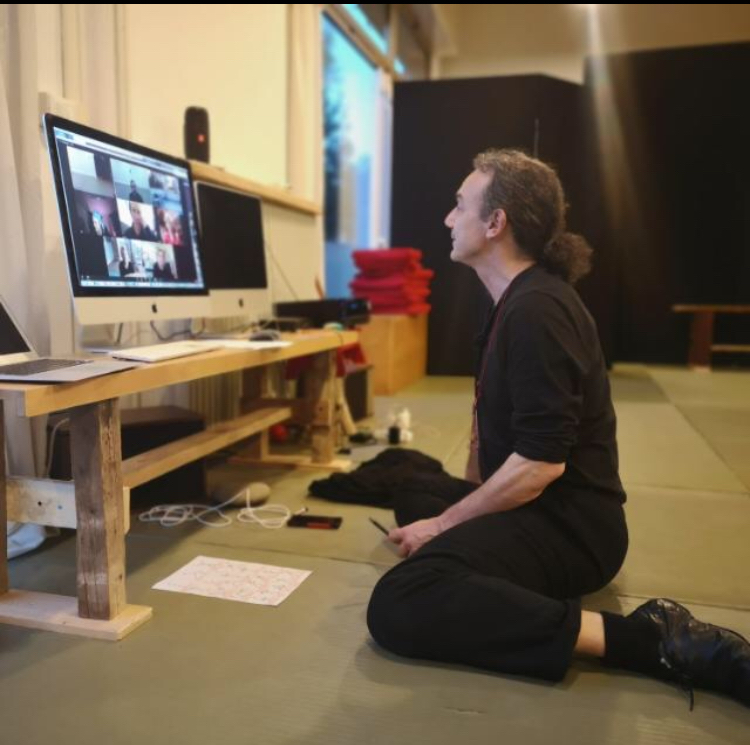
What I have discovered during these two years of pandemic, is that Zoom can be a greenhouse, or a nursery. Some gardening is possible. Some plants are actually doing OK, a few can even thrive. The remote connection can be a precious tool to maintain and cultivate relationships, to reflect on the work, to support each other emotionally, to refresh theoretical understanding, to review exercises. Some basic movement practices are possible, as well as some levels of writing and devising processes. And, of course, we can all prepare for the return to the fields.
It’s about keeping the fire alive, the soil worked, the seeds protected. And it can be very heartwarming, which is a priceless gift these days.

While collective work online is very seriously maimed, individual work maintains more potential. And it can operate as a an emergency channel. This damn pandemic eventually will end, and we will be grateful for the flames kept burning.

This is how Online Theater Pedagogy looks like.
The “pedagogy of the legless” in the words of Marcel Jousse


For all these reasons I prefer to call my work on-line PRACTICE, rather then teaching.
What I offer is

  • Individual consulting on devising projects
  • Individual pedagogic supervision or coaching
  • Pedagogic supervision in group
  • Theory classes and online conversations on specific subjects

I work only with practitioners with whom I have already worked and played in the context of live training, and who are active in the field. Or at least who have been active before the Covid storm.
If I don’t have already a preexisting embodied experience with a person and with their practice, I cannot establish a valid pedagogic engagement and relationship.

This is NOT the New Normal. It is a difficult, frustrating and challenging abnormal. In history, as in life, shit happens and this pandemic is a colossal one. Please remember and cultivate the longing for what we are missing and the grief for what has been lost. When this will be over, come back to the live poetic space wilder and more embodied than ever before. I’ll meet you there.


Giovanni Fusetti
January 202
2


TEACHING AGAIN

I was teaching again the other day
finally live after too many months
One studio full of light
Eight human beings in flesh and bones
Eight fools in heart and soul
Eight clowns in body and mind

The studio was so happy
that the windows did not want to close

The tatami was whispering
I missed your feet so much
The mugs were singing
we missed your thirsty lips
The benches were rapping
we missed your bumpy bum

I was teaching again the other day
and there was a distinct moment
when eight people were laughing together
and the teacher was speaking poetry about the work
and we were all laughing more
and crying a bit

And the teacher felt
Shall we lift our face masks?
We are all tested and well
and the windows are open
and the fans are blowing
and the play is rising
and the Muses are all here

Everybody agreed in a sight
and the medical masks were gone

The roof vanished
and everybody was suddenly flying
each face was the sun
beaming with joy

We all cried and shouted
and that was the end of the pandemic
by clowns acclamation


I was teaching again the other day
and I was so happy
and the group was so happy
and the teacher was so happy

And it happens that that teacher was me
the best part of me
the one who survived
during fifteen months of pandemic sadness
and came back with his eyes cleaned by dreaming
his heart refined by longing
his mind sharpened by poetry
his soul expanded by the lockdowns

I was teaching again the other day
and there was a distinct moment
when the teacher heard a voice in his eyes saying
I love so much this current instant
If we can all stay in this instant
and breath
and play
together
everything is going to be fine
for a very very long time

SEND IN THE CLOWNS

Isn’t it sad?
Are we adrift?
Me here again in lockdown
You on the screen
Where are the clowns?

Isn’t it sad?
Theaters are closed
You all out there starving for play
Me who can’t teach
Where are the clowns
Send in the clowns

Just when I want to make all my plans
Finally knowing that soon I’ll be playing with you
Teaching my classes again with my usual flair
Sure of my lines
No one is here

Don’t you miss play?
Don’t you miss joy?
I know that you want what I want
But now all is fear
Where are the clowns
There ought to be clowns

What a surprise
Who could foresee
I’ve come to miss you all more than the air that I breath
How hard to feel that we’re quietly drifting away
What a surprise
What a heartbreak

Isn’t it sad?
Are we adrift?
Me here again in lockdown
You on the screen
Where are the clowns?
Quick send in the clowns

Isn’t it sad?
Isn’t it mad?
We’re loosing our days, our life and our career
But where are the clowns?
There ought to be clowns
Well, maybe next year

Adapted from the song Send in the Clowns by Stephen Sondheim (1973)

I AM A DIGITAL LUDDITE

It is official. I am a digital luddite, a saboteur of algorithms, an analogical dinosaur.
Technology is an extension of human ingenuity, a great creative event that simplifies our life and allows us to perform tasks that our body or mind could not achieve. I am happy with that. But when a technology stops serving us, and we start serving it, I see addiction coming. And the regression of human qualities and skills. This is what I see happening with the Internet.
In the beginning I was browsing the net, now the net is browsing me.

The Internet drives me insane, literally: it triggers my mind and soul to loose gravitas, to loose weight, taste, touch and smell, making reality inconsistent.
I prefer real reality to virtual reality.
The virtual cannot replace the authentic.

I do not like the social media field. I do not want to be there.
I want to use direct communication with real people: I don’t want to say the same thing to everybody.
My voice is not the same when I speak to my friend, my father, my love or a person who is curious about my work.
If I have lost contact with my primary school mates, there must be a reason.
The structure and timing of social media is unreal and unhealthy to me: I find the fragmentation and multiplication of information and connections unbearable.
There is too much of everything.
I can process only a limited amount of connections if I want to be truly connected.
I don’t have and can’t have 1.000 friends, not even 500 or 100.
To call them contacts would be far more honest.
If I want to say something to the world there are websites, blogs, emails and books. They make sense to me. If I don’t reply to an email it means that I don’t want to, or that I am living beyond my true capacity of staying connected. The excuse that I don’t have time for it, so Facebook is a more efficient way to stay connected, is a lie. Time is limited and priorities need to be chosen.
I want to bear the consequences of my yes and no and I want other people to do the same.

I do not want to perform a conversation in front of an invisible public ready to perform their reply, not to me but to themselves and their public. This is a degeneration of communication that I do not wish to be part of.

The world is migrating from the real space to the cyberspace. This is an unprecedented change in the collective consciousness and in the neurology of humankind. At the same time our civilization is destroying the planet ecosystems, in a collective lack of presence, attention, awareness and physical care. I find these two phenomena deeply connected. This migration online worries me: cyberspace is an illusion of space in which everybody performs the identity that they wish to show to the world. A performance of the self without the constraints and feedback that are given by the real space of the physical existence and the reciprocity, density and complexity of embodied contact.

I am a primate, I am a social animal. I don’t have a body, I am a body. I need and want an embodied social life.

I am tired of too much information.
Information is not knowledge: true knowledge needs to be felt and interacted.
We are loosing the dialogical space, and I see social media as a mutually interconnected series of monologues. An epidemic of self-publishing narcissism.
When I post something online I post myself to myself.
It is self advertising disguised as interpersonal communication.
Facebook treats its users and their data as products. Users treat themselves and their news as products, to advertise on the stock market of the ego. With the value defined by the number of likes.

I don’t want ads: I despise advertising.
I strongly disagree with the commercial use of the social instinct of people.
I do not like the idea of selling the human social instinct to advertising companies.
I do not want to have my entire life and relationships permanently kept and monitored in order to become a target for advertising. I really don’t like to be used as a specimen for a huge commercial operation. I don’t want advertising in my living room, why would I want ads in the messages to my friends?
Advertising for profit is a very poor use of art, technology, psychology, communication and creativity towards the manipulation of minds, in order to promote consumerism and the unfolding of a profit oriented civilization.
I actively wish for the historical day in which commercials and ads will be banned as a form of pollution of mental environment. I am sure that many plants and animals of Planet Earth will agree with me on that.

I despise the founder of Facebook and his radical lack of ethics. He acts as a global anti-social psychopath: manipulating consent, violating privacy, selling private information and personal profiles, promoting fake news for corporate gain, damaging democracies, upfront lying.

Look at his eyes and you will know and feel why Facebook is an anti-social network.

I am sick of the digital world: I spend already far too much time on my computer, sitting for hours in front of the fluorescence. I am hooked to emails and news. When I travel I am always looking for a WIFI network to stay connected, to be always everywhere with everybody at all times. I feel that my brain is more restless than it used to be. Internet disturbs my process of learning by reducing my capacity of deep focusing. I find reading books harder then before the internet era.

The internet connection disconnects me from the deep currents of my soul, psyche and dreams.
I am a physical living being and I want my analogical life back.
As a digital luddite, I practice digital detox, reducing my exposition to virtual digital life and maximizing my time with the real life and with the body: mine, other people’s and other living beings.
I miss the body of the planet.

At the beginning I thought the net would help. Now it has gone too far. Far too far.
I have drawn a line not to be crossed: the internet is a tool, it is not a space nor a time. If it serves to support the quality of the real life I will use it. If it demands me to leave my embodied life for a legless artificial life I’ll say no thanks.
I am happy to use a website. I do not wish to become one.

I am not upgrading anymore. And when possible, I am retrograding my systems and my processes. I miss my analogical self. I want it back.

The web is a wonderful and limitless resource and it is a voracious monster: I cannot keep a T.Rex as a pet. It will eat me alive. It is its nature.

I want hyper-connectivity with my soul, my body, my people and with nature, not with the web and not through the web.

It is never too late to turn off the machines.

THE WINTER FALL

Curled into the laziness of a locked day
my worries unfurl like a fern
buried in the winter of the couch.

I am a bulb of an ancient flower
wondering if I will ever bloom again.

The memory of my life before
is a cushion of wool and longing.

Time tastes like pipe smoke and wine
space glooms in slow iridescence.

In the distance
the redundant voices of the radio
discuss the composition
of the next social pastiche.

I used to be a human
now I am a cage full of colors.

November 3rd, 2020

WHY I DON’T TEACH PHYSICAL THEATER ONLINE

ANTIVIRAL NOTES IN DEFENSE OF THE PEDAGOGY OF THE POETIC BODY.

There is no such a thing as Virtual Physical Theatre. As much as there is no such a thing as Virtual Gardening. Or Digital Hiking. There is performance on-line. There is coaching on zoom. There is pedagogic supervision. There is facilitation of creative processes. There are conversations on the work, review of exercises and theories. There can be practice with the creative potential of the medium. There are plenty of options. Can we teach and learn online? Certainly we can. The question is what.

We can practice a live embodied art online as long as we are aware that it is a surrogate of the real experience. As long as we frame it as such.

During this pandemic pandaemonium, in the impossibility of live events, we have gathered online to keep the flame burning. I have done it too and I am having some great experiences with former students or practitioners with whom we have ALREADY experienced the work and the play in its live form. We already have a common poetic body and space to practice in, and we already have an embodied experience of each other. So we know where the work comes from and where it will end: in a live and embodied shared poetic space and time.

Can I teach that poetic space and time to new students online?
Can I teach the profound collective ecstasy of the theatrical event online?
Can I hold the space for the alchemy of the co-creation between the player and the audience?
Can I facilitate the unfolding of clowns, characters and bouffons with the full support of the embodied emotional energy of the class and of myself?
Can I give feedback on the stupendous variety of embodied events that appear at the threshold between the person and the mask, between the mask and the space, between the space and the audience, and eventually between us all and the Goddesses and Gods of theater?
My answer is No.

That is why I am not doing online training in physical theater with new students. It would be a professional cheat on my side. I would be teaching a surrogate to a beautiful art. In doing this I would disrespect, diminish and eventually damage the individual and collective poetic field. And myself in it.

The virtual cannot replace the authentic.

We can do online training in online performing. I think this is a whole new genre there, to be explored and developed. Certainly great work is emerging. But I am not interested. It’s not my medium. As much as I don’t do video or cinema – I love good videos and movies. Those are wonderful arts but not my practice, nor my skill. I do movement based theater, also known as physical theater. It is the best technology I know to explore the world as it is and as it could be. And to communicate it.

I love my practice and I love teaching it. Now I miss it tremendously.
In these times of absence I am cultivating the longing-craving-dreaming-starving-burning desire for the return of the bodies with bodies. Now it’s winter, and there is snow on our fields. Spring will come. It might take long. The empty space is where the poetic potential prepares the next gestures and the emergence of the forms of the new stories.

Theater has survived far worse scenarios than this.

The Venice plague of 1575 killed 50,000 people, which at the time was a third of the population of the city. You make the comparison with our Covid numbers.

Formally, Commedia dell’Arte appeared in Padova in 1545, and was in full bloom by the end of that century. The contagion was just a pause in the unfolding of this stupendous art. A stand-by, a call of movement.
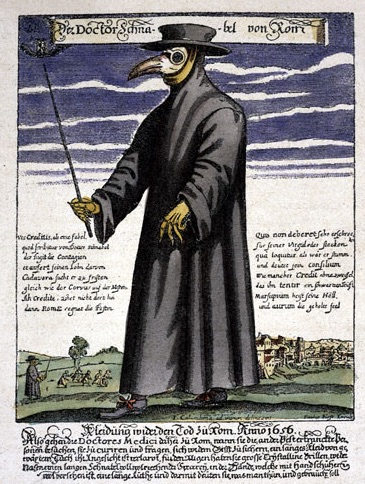
The Plague was a returning event in the following century and Venice Carnival created a new character, il Medico della Peste (The Plague Doctor) to acknowledge it. The costume was based on the outfit doctors were using to protect themselves from the contagion: ankle length black robes, white gloves and a large beaked mask with small glass eye holes. Inspired by the strong aesthetic of the newcomer to the mask family, many of the Venice Carnival Masks got an upgrade and grew longer noses.

Illness, symptoms and the fear of dying are recurrent themes in the comic lazzi of Commedia dell’Arte.
Will we dare to face The Covid with the wild humor of our ancestors?
Will we improvise the Lazzo of Arlecchino sanitizing his hands?
Will we create a new type to play with our collective experience of this new plague?
Shall we name him Covidello? This will be a tribute to one of the most ancient servants in Commedia, Coviello, whose origins are in the ancient Latin fertility rituals. He will be our new version of the Fool who, as long as keeps playing, cannot die.Will we write the Adventures of Covidello in the City of the Virus?
Will we perform it in our streets or on zoom? It’s our choice, and this choice will define the world we will want to live, love, work, play, laugh and die in.


Giovanni Fusetti

Padova, Italy, May 31st, 2020